Understanding Unit Trust Distributions: Why They Are Income Distributions, Not "Dividends“
One of the most persistent misconceptions among investors revolves around the term "dividend.“
It is common to hear an investor state, "My unit trust fund paid a 5% dividend this year." Naturally, investors tend to equate a dividend with extra profit, similar to receiving a bonus or earning interest on a fixed deposit.
However, within the regulatory framework governing Unit Trust Schemes (UTS) in Malaysia, referring to a fund payout as a "dividend" is. A unit trust fund pays out an "income distribution." While this distinction may seem like technical jargon, the underlying financial mechanics between a corporate dividend and a fund distribution directly impact how your investment capital operates.
Stock Dividends vs. Fund Income Distributions
To understand why these terms are not interchangeable, it is essential to examine where the payout money originates and how capital is impacted:
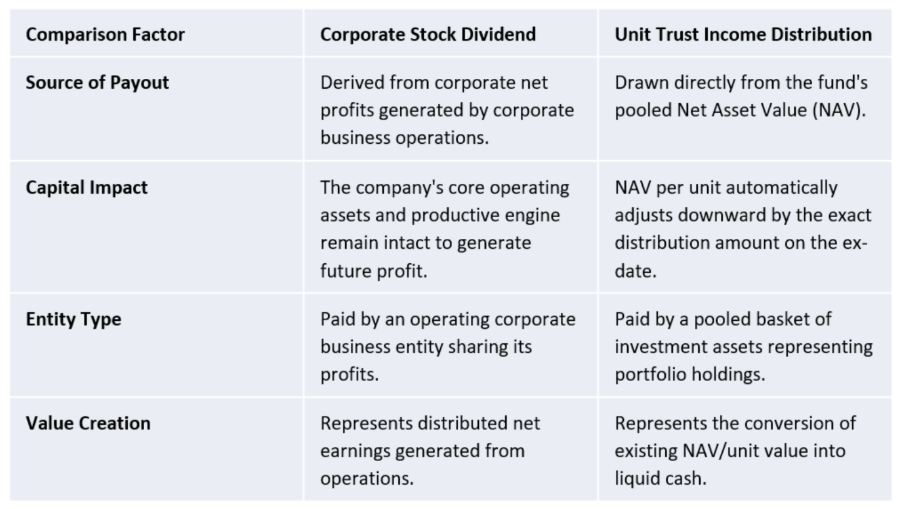
A true dividend is paid by a corporate entity sharing its net profits. When a public company earns a profit through its business operations, its board of directors may choose to distribute a portion of those earnings to shareholders as cash. Although the stock price adjusts slightly on the ex-dividend date, the company's core operations, assets, and business engine remain fully intact to generate potential future earnings.
Key Takeaway on NAV Adjustments:
On the distribution ex-date, the fund’s NAV per unit drops by the exact amount paid out per unit. For example, if a fund’s NAV is RM1.00 per unit and it declares a distribution of RM0.05 per unit, the NAV per unit automatically drops to RM0.95.
An income distribution is not newly created wealth or a guaranteed bonus; it is the conversion of RM0.05 of your existing unit value into cash.
Sources of Fund Income Distributions
Fund managers declare an income distribution based on realized earnings gathered within the portfolio basket. These payouts originate primarily from two sources:
Realized Income: Interest earned from fixed deposits, money market placements, bond coupons, or stock dividends collected from the underlying companies held inside the portfolio.
Realized Capital Gains: Profits realized when the fund manager sells an underlying portfolio asset that has appreciated in value.
Distributions During Market Downturns
Investors are often puzzled when a fund declares a distribution during a year when its NAV per unit is falling. If the general market experiences a downturn, a fund's overall NAV per unit may decrease due to market depreciation of its holdings. However, if the fund manager accumulated realized income or realized capital gains earlier in the financial year, the fund retains the technical ability to declare an income distribution.
Understanding Capital Risks: Unit Trusts vs. Fixed Deposits.
Understanding payout mechanics is vital for maintaining long-term financial health, especially when comparing variable-price investment products against fixed-income deposit instruments.
Risk of Capital Erosion
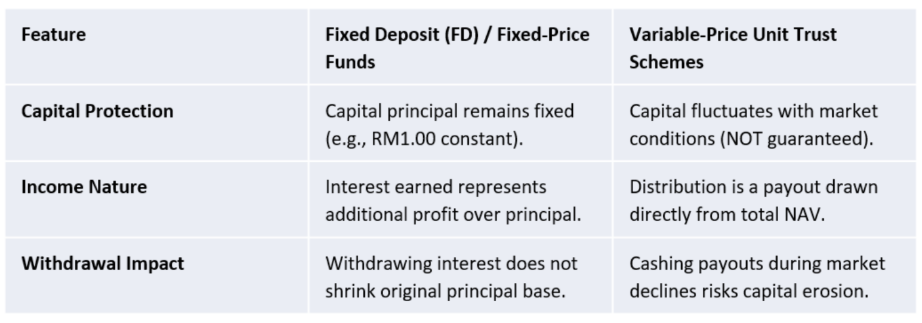
When holding a Fixed Deposit (FD), your principal capital remains static. The interest earned represents genuine income above your capital, which you can withdraw and spend without shrinking your original principal base.
In contrast, unit prices in variable-price unit trust schemes fluctuate based on market movements, and investment returns and capital sums are not guaranteed. If an investor receives an income distribution from a variable-price unit trust during a market downturn, cashes out the payout, and spends it, they risk unknowingly eroding their investment capital. Because the distribution physically reduces the NAV per unit, taking cash out during a declining market leaves a smaller capital base actively invested inside the fund. When market recovery occurs, the reduced capital base cannot compound as effectively as it would have had those distributions been automatically reinvested to purchase additional units.
Making Informed Portfolio Decisions
Taking a cash income distribution from a unit trust is a valid portfolio strategy when aligned with specific financial goals:
Income-Focused Investors & Retirees: For investors who require regular cash flows to cover living expenses, cashing out distributions fulfills an intentional income objective.
Growth-Oriented Investors: For investors seeking long-term capital growth, reinvesting distributions allows them to acquire more units, maximizing the potential benefits of compound growth over time.
Summary
An income distribution from a unit trust is not a guaranteed bonus on top of a protected principal. It is a distribution from your total portfolio value. Recognizing how distributions impact NAV per unit empowers you to make informed decisions on whether to receive cash payouts or reinvest them to support long-term wealth accumulation goals.